
After years of balancing the heavy responsibilities of being a young carer with a deteriorating home situation, 24-year-old Abi, who falls outside of the care system but needs significant support, found herself navigating the complex world of independent living alone. Until she was referred to Floating Support.
For Abi, “home” was never a place of rest or place to be a child. From primary school age, she was a young carer for her brother, who has complex needs. “Mum was a single parent for most of our life. I’m the oldest as well, and I think being from an African culture, it’s very typical for the oldest girls to kind of be that second mum,” she explains. Home was often volatile, and she recalls her brother’s violent outbursts:
“It was very stressful because there’s times where I couldn’t manage his behaviour and it would cause me distress. He would try to escape the house… it caused a lot of stress and anxiety.”
By the time she reached sixth form, the pressure caused her mental health to deteriorate. “I was just really struggling. My anxiety started to get really bad where I started to skip certain classes.” When the pandemic hit, the confinement made her feel even more insecure. “It just didn’t feel like a safe space anymore, both because of my brother and also because of the relationship with my mum.”
“Things were so hostile, at any moment I felt like I was going to be kicked out of the house. I kept all my stuff packed and ready to go. I kept asking friends, ‘If it happens, can I stay with you a couple days? Can I keep my stuff at yours?’”
The situation became untenable as Abi spent years in a state of hyper-vigilance. “I was doing research on what age I could leave home without having to be brought back, because I knew if I just ran away, the police would just bring me back.” she explains. Eventually, after a particularly bad episode, she was referred to Child and Adolescent Mental Health Services (CAMHS). It was at this critical moment that she began to realise her situation was a crisis that required specialist intervention, leading her to finally seek a path out of her family home.
Getting the keys to her flat was only the beginning of a new struggle. “I have no idea what I’m doing,” Abi remembers thinking. “I’ve just moved to a place where I don’t know how to set up the bills… I had nothing, I had two pots to cook with to my name.”
Abi falls into a forgotten category. She isn’t a care leaver and doesn’t qualify for the statutory help given to care leavers, yet her needs are similar – she was at risk of falling through the cracks. It was at this point she was referred to our Southwark Floating Support service, a team dedicated to supporting young people at-risk of homelessness move towards independent living.
Floating Support worker, Graeme, became her anchor. “I made a lot of mistakes when I first applied for grants and benefits. I didn’t know what I could apply for or how certain things worked,” Abi recalls. “It wasn’t until Graeme came along and helped me with the applications. There was a lot of back and forth, but August 1st is when I got my bed and mattress, and that’s when I fully moved in.”
Graeme acted as a guide through the minefield of independent living, helping to set up her utilities so she wouldn’t be overwhelmed by debt.
“Graeme is a very friendly person, very understanding, has that ear to listen and gets the job done,”
Before Graeme’s support, she was often eating only one meal a day to save money. “Sometimes it was cheaper for me to have sugary drinks to curb the hunger than actually eating.” Graeme arranged referrals to food banks to ensure she was nourished while she got on her feet.
With her housing and finances stabilised, Abi’s anxiety has become more manageable. She feels empowered to ask for help when she needs it, knowing that the team at Depaul UK is an “umbrella” of support. Today, Abi is focusing on her health and her education. While she acknowledges “it’s not really feasible for me to be at uni right now,” she recently completed a short teacher-training course that she loved.
With the security of a new home and Graeme’s dedicated support, Abi has found the stability she needs to start thinking about building a future. Moving forward with a renewed sense of agency and a focus on her education, Abi has good reason to feel optimistic about the next stage of her life.
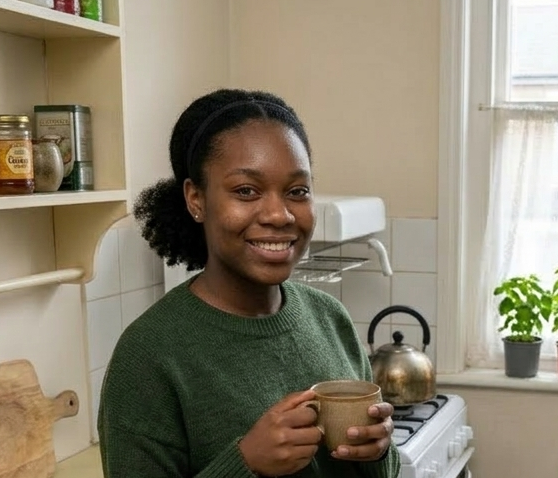
Abi’s image are AI-generated, helping us improve safeguarding while keeping production costs low.