

Could you spot the signs that a young person is at risk of homelessness?

Test your knowledge this World Homeless Day and find out.

Test your knowledge


World Homeless Day: Why early warning signs are key to preventing homelessness

Youth homelessness rarely happens overnight.

For many young people it’s the result of challenges that build up over time – family breakdown, conflict at home, rejection or a lack of support, financial pressures, changes in family circumstances. Family breakdown is the leading cause of youth homelessness in the UK, and it’s rarely one single moment.

Yet long before a young person reaches crisis point, there may be signs that something is wrong.

A change in behaviour. Increased anxiety. Reduced attendance. Arriving early or leaving late. Withdrawing from friends or activities.

One sign alone doesn’t tell the whole story. But schools, teachers and the trusted adults who see a young person every day are often in a unique position to notice those changes, open up conversations, and help them get support earlier.

That’s where youth homelessness can be prevented, before it starts.


TEST YOUR KNOWLEDGE


This isn’t about getting every answer right. The warning signs of youth homelessness can be genuinely difficult to notice, especially when a young person is trying to hide what they’re going through. Test your knowledge and learn how to recognise them.


Test your knowledge

A real story

Close up of a young person holding of a cup of tea

At 16, Kerry’s relationship with her mum broke down. For the next two years, she moved between friends’ sofas and her grandmother’s house, never feeling settled or secure.

Today, she works for Depaul UK as a Reconnect worker, helping other families avoid the same experience.

“I can now see it from my mum’s perspective,” Kerry says. “She did try. But she didn’t have enough support, and neither did I.”

Kerry’s work starts with something simple: listening. She helps young

people find the words for what they’re feeling, and helps families argue well instead of not at all. “We’re not teaching them to avoid conflict,” she says. “We’re teaching them how to argue well, to disagree without it destroying everything.”

Often, it’s the first time a young person has felt properly heard. “A lot of young people don’t feel heard by adults,” Kerry says.

“So much of the feedback I get is: ‘I felt heard.’ That is often all it takes to start the change.”

Our education programme

Depaul UK’s education programme helps schools recognise the risk of homelessness alongside other safeguarding concerns. Our workshops give staff practical knowledge of housing rights and where young people can find support, while helping students understand homelessness and feel more confident asking for help.

Last year, almost 15,000 young people took part in whole group workshops, almost 600 in targeted sessions, and almost 400 professionals were trained.

Find out about our education workshops


Go deeper

Want to understand more about how family breakdown leads to homelessness and how it can be prevented?

Read more on our blog.

Read the blog


Do you support young people?

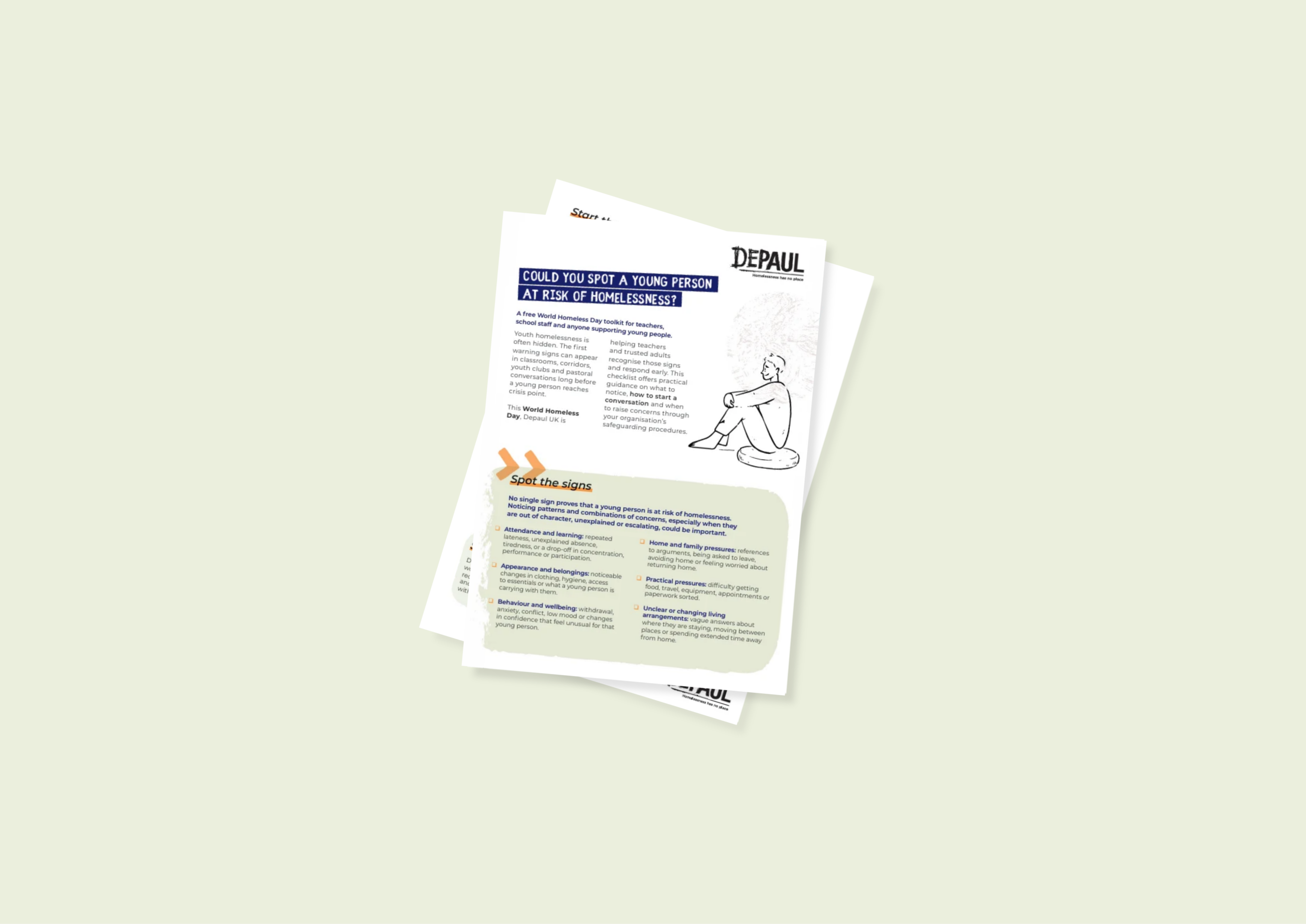
Download our free Spot the Signs toolkit – a practical checklist for anyone supporting young people. It covers the early warning signs, how to start a conversation safely, and what to do next.


15000 young people took part in our workshops last year.
400 professionals were trained to spot the signs.
Icon of a heart 88 of young people said they'd be more likely to ask for help afterwards.
97 of professionals said they had a better understanding of what to do next.

Before you go

Know someone who should see this?

Share it so more people can learn how to spot the signs.

Share on Facebook Share on LinkedIn Share on WhatsApp

Read more on our blog

Curious to know more? Our blog gives more insight deeper into youth homelessness.

Read the blog

Follow along

Want to see more? Follow us on social media.

Instagram | Facebook | LinkedIn